
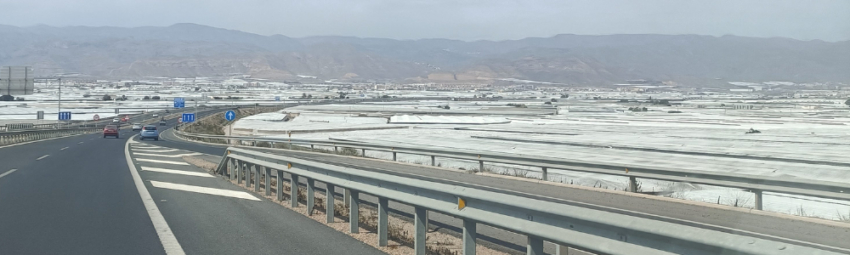
The “Sea of Plastic” is a conversation that almost always comes up when we’re helping our clients move to Spain. Many choose the coastal lifestyle of Almerimar, living right in the heart of this vast, shimmering landscape of 33,000 hectares of greenhouses—one of the few man-made structures visible from space. Others prefer the mountain charm of Albox or nearby Arboleas, but what is the significance of these areas to Europe’s dinner tables?
While we often use the tomato as the primary example, Almería is actually the “market garden” for the entire continent. Beyond the famous tomatoes, this region produces an incredible variety of fresh food: from 60% of Spain’s pepper exports to the vast majority of Europe’s winter cucumbers, aubergines, and courgettes. In fact, if you’ve eaten a crisp salad in the UK during the winter, there is a very high chance the lettuce was grown in the province of Almería, with Almerimar sitting at the centre of production, while inland Albox acts as the “engine room” for the region’s circular economy.
Why Albox Matters
To understand why Almería is becoming “greener,” you have to look at the “back office” of the industry. While the growing happens on the coast, the environmental solutions are often found further inland.
Albox is the perfect example. While our clients there and in Arboleas enjoy a traditional, mountainous backdrop, Albox houses a critical facility for the province. The Geocycle (Holcim Group) plant in Albox is the unsung hero of the region. It doesn’t grow the vegetables; it “eats” the waste. This facility specialises in co-processing, taking agricultural plastics that are too degraded for traditional recycling and transforming them into high-energy alternative fuels. This prevents plastic from sitting in landfills and instead uses it to power cement kilns, replacing fossil fuels like coal.
The “Carbon Paradox”: Is Local Always Better?
There is a common argument in the UK that locally grown produce is always the better choice for the environment, but is that really the case? Many assume a British-grown pepper or tomato must be greener simply because it didn’t travel 2,500 km in a truck.
The data says otherwise.
According to standardized Life Cycle Assessments (LCA), the carbon footprint of a vegetable is determined more by how it is grown than how far it travels.
In the UK: Growing salad crops in winter requires massive amounts of natural gas to heat greenhouses to 20°C and provide artificial light.
In Almería: The sun provides 100% of the heat and light.
Research confirms that heating a greenhouse in a cold climate is roughly 10 to 40 times more energy-intensive than the “passive” solar method used here. Even after factoring in the refrigerated truck driving from Almerimar to a UK supermarket, an Almerían salad still has a significantly lower total carbon footprint than one grown in a heated UK greenhouse.
1. The UK/Dutch “Heating” Data
The high carbon figure for Northern European produce 3.5 kg – 5.2 kg CO2 comes from energy demand. Studies by Wageningen University show that heating a glasshouse in a temperate winter requires roughly 40-150 MJ (megajoules) of energy per kg. Since this primarily comes from burning natural gas, the emissions are high and constant.
2. The Almería “Production” Data
Data from the Cajamar Experimental Station shows a production footprint of only 0.15 kg – 0.25 kg CO_2. Because no gas is used for heating, the “carbon debt” is almost entirely tied to infrastructure and solar-powered irrigation.
3. The “Transport” Math
Transporting produce from Almerimar to the UK is approx. 2,500 km using official UK Government (DEFRA) factors. heres the summary.
A modern refrigerated truck carries 20,000 kg of produce.
The “transport tax” is only about 0.12-0.20 kg of CO_2 per kilo.
Total Calculation: Almería Production (0.20 kg) + Trucking (0.18 kg) + UK Cold Storage (0.10 kg) = ~0.48 kg CO_2 per kg.
When compared to the 4.80 kg CO_2 average for a heated greenhouse tomato grown in the UK, the Almerían tomato’s footprint is exactly 10 times lower
The “Albedo Effect”: A Cooling Miracle
While the white plastic covers are a striking sight, they are doing something remarkable for the local climate. While the rest of the Mediterranean is warming, the Almería greenhouse region has actually seen a local temperature drop of about 0.8°C.
This is known as the Albedo Effect. The white plastic reflects sunlight back into space, preventing the ground from absorbing heat. Scientists, including the team led by Dr. Pablo Campra at the University of Almería, consider this a powerful, accidental “geo-engineering” tool that helps mitigate the local effects of climate change.
The 2026 “Green” Revolution
The industry is currently undergoing its biggest transformation. By the start of 2026, several major milestones were reached:
Biodegradable Materials: Almost all the strings (raffia) used to support plants have been switched from plastic to compostable jute or cellulose, making the plant waste 100% organic and easier to process at inland hubs.
Solar-Powered Irrigation: Farms are moving away from the grid, using solar arrays to power water desalination.
Zero-Waste Mandates: New laws now require strict waste separation at the farm level, meaning more material than ever is heading to plants like the one in Albox for a second life.
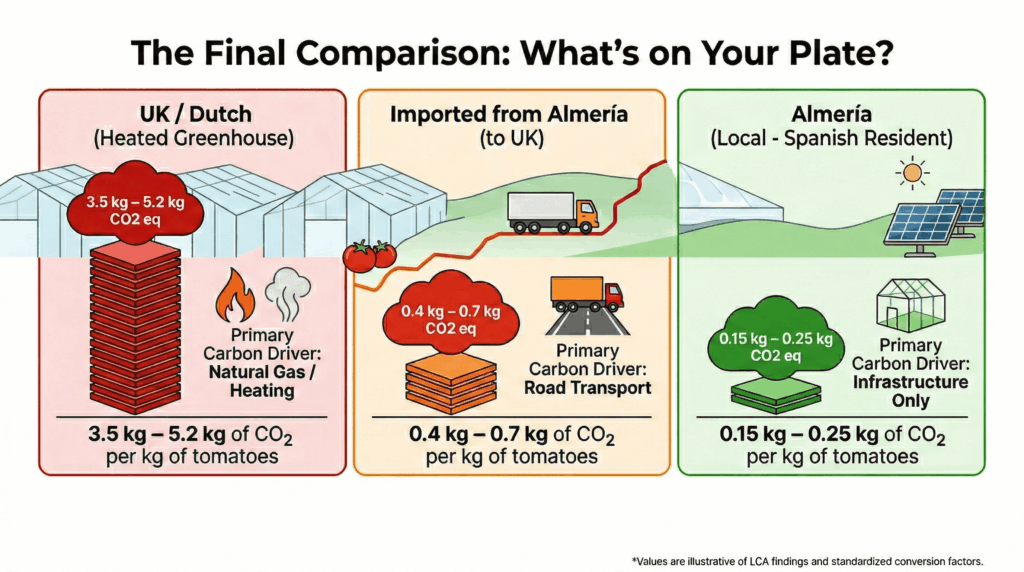
Eating locally in Almería results in a salad’s carbon footprint that is up to 20 times smaller than that of a supermarket equivalent grown in a heated UK greenhouse. Whether you are settling into a villa in Albox or Arboleas, or a marina-front apartment in Almerimar, you are part of one of the most energy-efficient agricultural systems on Earth!
Sources & Technical Data
To ensure access to the primary research mentioned in this article, we have compiled the official sources and calculators used for our findings:
University of Almería (UAL) – The Albedo Effect: Global and Local Effect of Increasing Land Surface Albedo (ResearchGate)
Cajamar Experimental Station (Las Palmerillas): Estación Experimental Cajamar Official Site and LCA of a tomato crop in a multi-tunnel greenhouse (ResearchGate).
Wageningen University (WUR) – Energy Comparisons: Energy Use in Greenhouses in the EU – Review & Research
UK Government (DEFRA) – Carbon Conversion Factors: Greenhouse gas reporting: conversion factors 2025 (GOV.UK)
Geocycle (Holcim Group) – The Albox Recycling Hub: Geocycle Spain – Albox Plant Operations