
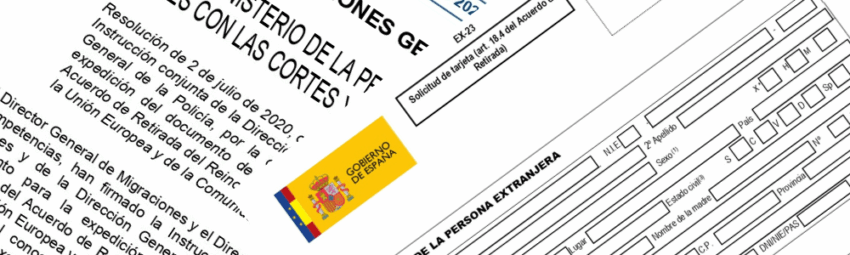
One of the most common problems we’re coming across at the moment with Withdrawal Agreement renewals is people being asked for the wrong form when making the application. To be clear, the correct document for UK nationals protected under the Withdrawal Agreement is not the EX-17. There’s a lot of false information out there, reports of people being told by the authorities that the EX17 is the correct model.
So, let’s break down what each form actually means, what the law says, and what to do if the police insist on using the wrong one.
Form EX-17 is used by third-country nationals who already hold, or have been granted, a residence or work authorisation in Spain. It’s the form that accompanies existing immigration permissions — for example, visa holders, renewals, or residence permits under Spain’s general immigration law, the Ley Orgánica 4/2000 sobre derechos y libertades de los extranjeros en España y su integración social.
You can read that law here (Article 4 and following):
👉 Ley Orgánica 4/2000, de 11 de enero, sobre derechos y libertades de los extranjeros en España
In short, EX-17 is part of the national immigration framework, not the Withdrawal Agreement framework. It is perfectly valid for most non-EU nationals but not for UK citizens protected under the Brexit Agreement.
The Legal Basis for the EX-23
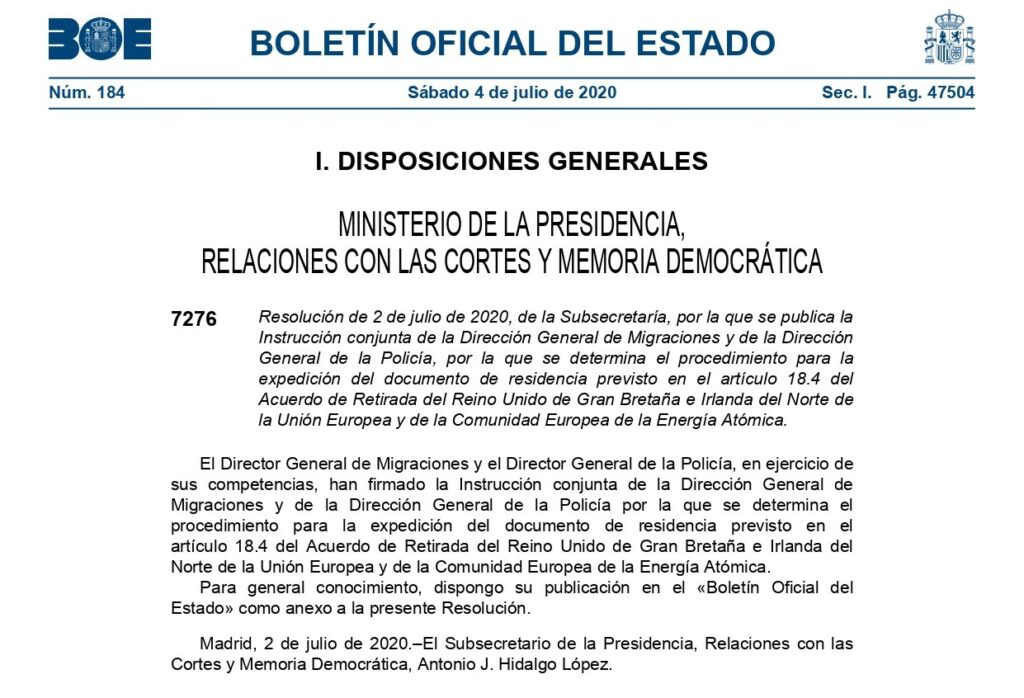
For UK nationals and their family members covered by the Withdrawal Agreement, the correct form is EX-23. This comes directly from the Resolution of 2 July 2020, published in Spain’s official state bulletin (Boletín Oficial del Estado – BOE-A-2020-7276).
That resolution establishes the procedure for issuing residence cards under Article 18.4 of the Withdrawal Agreement between the United Kingdom and the European Union.
You can read the full legal text here:
📄 https://www.boe.es/boe/dias/2020/07/04/pdfs/BOE-A-2020-7276.pdf
The law clearly states that the only model established for this purpose is EX-23 – Solicitud de tarjeta (artículo 18.4 del Acuerdo de Retirada). This form is specifically designed for beneficiaries of the Withdrawal Agreement, recognising their rights under Article 50 TUE and confirming their residency in Spain before the end of the Brexit transition period.
What Happens If You’re Told to Use EX-17 Instead?
We’ve spoken directly with the main Comisaría in Málaga about this issue. Their view is clear: if your details are already registered in the system as a Withdrawal Agreement beneficiary, your rights will not be lost — even if the wrong form is used.
Your legal right of residence depends on your status in the central system, not the form you handed in at the police station. The TIE card is simply proof of that status, not the source of the right itself.
This aligns with both UK Government and EU guidance, which state that rights under the Withdrawal Agreement are not dependent on the possession of a valid TIE card.
🔗 https://www.gov.uk/guidance/residency-requirements-in-spain
That said, it’s still best to insist — politely but firmly — on using the correct EX-23, as it ensures your record remains accurate and avoids future complications.
It’s also worth remembering that, even if you are a beneficiary of the Withdrawal Agreement, it is not imperative that you hold a TIE card to prove your status within the Withdrawal Agreement itself. you would have to be crazy not to get a TIE card!Aside from the administrative problems on a day-to-day basis with the rollout of the Entry/Exit System (EES) across the EU, having a valid TIE card can make border crossings and administrative processes smoother.
Why This Confusion Keeps Happening
Many police officers and immigration clerks now processing renewals simply weren’t working in the same roles back in 2020, when Brexit procedures first came into force. For several years, they’ve mainly handled EX-17s for standard immigration cases, so it’s understandable that the EX-23 isn’t as familiar.
The EX-17 form crosses desks daily for visa renewals and residence authorisations under Ley 4/2000, while EX-23 applications are relatively rare and only relate to a specific group — UK nationals who moved to Spain before 31 December 2020.
As a result, when officers see “British passport”, they sometimes default to the standard third-country procedure, unaware that Brexit residents follow a treaty-based route.
What To Do at Your Appointment
Bring a printed copy of the BOE Resolution of 2 July 2020, which references Article 18.4 of the Withdrawal Agreement (page 47,508/9). If you encounter resistance, show this reference — it’s official law and clarifies that EX-23 is the proper model.
If you’re forced to use EX-17, don’t panic. Your treaty rights are secure. But it’s worth noting the incident and, if possible, follow up later with the correct EX-23 submission.